How I rescued a 1987 USENET game, tracked down its creators through time and brought it into the modern era
Author: Juan Méndez (vejeta) | September 2025
PROLOGUE: The Echo of a Lost World
*«I heard news of the request to release the code. I grant permission to release the code under GPL.» * — Adam Bryant, 23 February 2011
*«I enjoyed the article and liked seeing the map images in particular. It definitely brought back very fond memories! If only working a job to pay the bills hadn’t gotten in the way…» * — Adam Bryant, September 2025
Fourteen years separate these two messages. The first rescued a stalled project; the second revealed the emotional depth of a digital era that no longer exists. This is the story of how a two decade obsession gave the voice back to the pioneers of software and built a bridge between two irreconciliable Internets.
CHAPTER 1: The Digital Time Capsule (1987)
Image: Full screenshot of the original «conquest» posting showing the shar code.
26 October 1987. While most of the world did not even imagine the Internet, on the USENET servers a user called ihnp4!mhuxd!smile (Edward Barlow) posted in comp.sources.games:
v02i058: conquest – middle earth multi-player game, Part01/05
This message was more than an announcement; it was an artefact of a philosophy that would define an era.
The Logistics of shar: When Software Travelled in Fragments
Downloading Conquer in 1987 was not a click. It was a rite of technical initiation:
bash
#! /bin/sh
# This is a shell archive. Remove anything before this line, then unpack
# it by saving it into a file and typing «sh file».
Each one of the 5 parts was a script that contained the code encoded as text. The process required:
- Manually downloading each part from USENET
- Running sh parte01 to rebuild the files
- Repeating for parts 2-5
- Compiling manually with cc -o conquer *.c -lcurses
If part 3 failed, the process stopped. There was no resume download. You waited days or weeks until it reappeared in the feed.
The Collective Act of Faith
Publishing in comp.sources.games was sending your work to the scrutiny of thousands of the best engineers in the world. There were no curated stores or prior reviews. The community was the quality control.
Ed Barlow included this note in the README:
«What you have here is a copyrighted beta test version of CONQUEST.»
There were no “closed betas”. It was trusted that anonymous users at universities all over the world would test it, report bugs and improve the code. It was open source before the term existed.
CHAPTER 2: University Days – The Discovery (1990s)

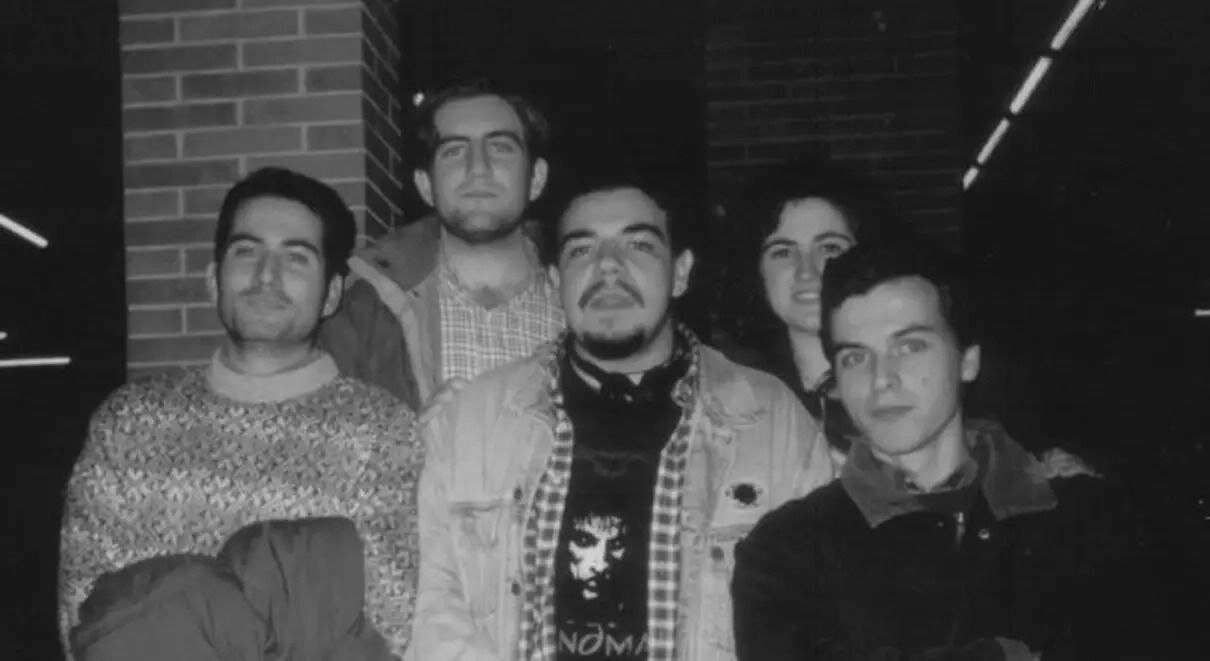
Photograph of the Unix laboratories of the Universidad de Sevilla in the 90s.
In the mid 90s, as a student in Sevilla, I spent countless hours in the Unix labs exploring an emerging digital world: green terminals, USENET, links, news, msgs – and, of course, Conquer.
The game was revolutionary. As the leader of a nation, you controlled your elven realm, orc empire or human armies across a map rendered in ASCII characters. The depth was astonishing:
- Detailed economic management by sectors
- Complex diplomatic systems between races
- Magic and spells with effects on the world
- Exploration of unknown territories
The Social Ritual of the Game
It was not a solitary game. The ritual was deeply social:
- Connecting by SSH to a shared Unix machine
- Making moves during the day between classes
- Waiting for the nightly conqrun that processed the turns
- Receiving emails with the results every morning
We organised games that lasted weeks, with daily or weekly turns. The slowness was a feature, not a defect. It allowed deep strategy and created community around the text.
I have not found photos of the room from that time, but I have found its description in the old pages of the faculty:
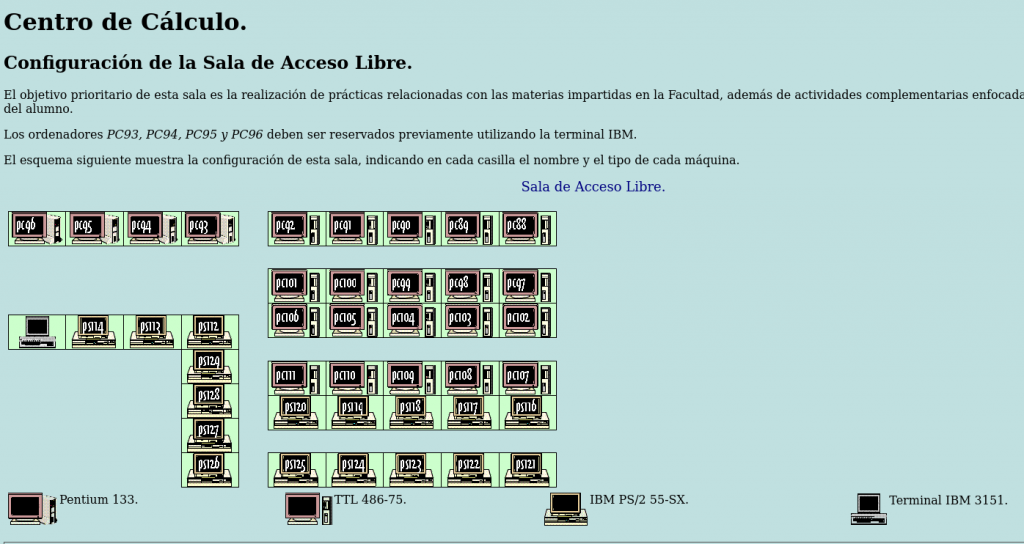
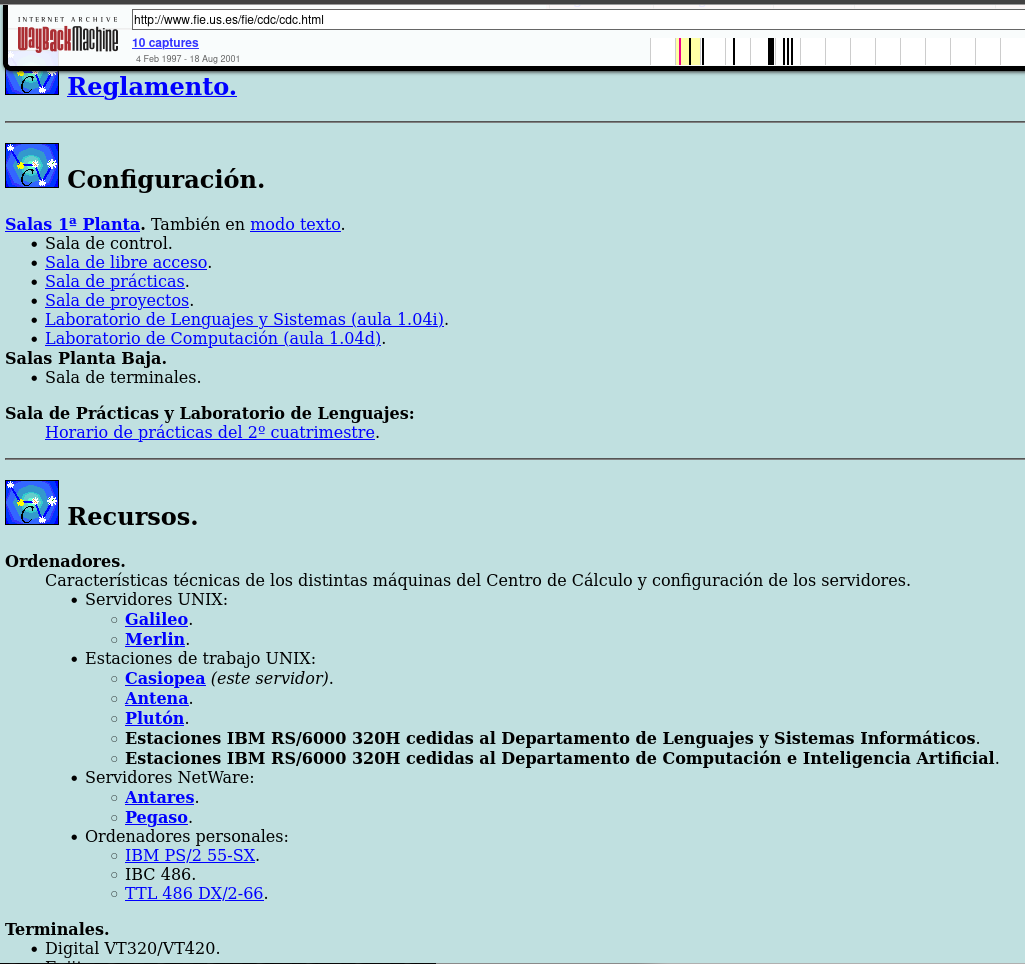
CHAPTER 3: The Search Begins – Digital Detective (2006)
Image: Full screenshot of the thread on debian-legal showing the initial query.
By 2006, this piece of computing history was trapped in a legal limbo. I started what I thought would be a simple project: getting permission to relicense the code under GPL and package it for modern Linux distributions.
Finding the original authors was digital archaeology. The emails from the 80s had been dead for years. I examined old university directories, followed digital breadcrumbs and eventually contacted Ed Barlow.
The “Do It and See What Happens” Philosophy
Our instant messaging conversation in 2006 revealed the mindset of the era:
(18:08:58) vejeta: *Sorry if I catch you busy. While trying to investigate if I could relicense old conquer as free software I discovered it was complex. * (18:14:00) Ed Barlow: *i personally would say that you should do it and nobody will know the difference * (18:18:52) vejeta: *Indeed, I feel like a detective 🙂 * (18:21:23) Ed Barlow: v4 was both of ours… i wrote v4 he wrote v5…
When I asked about previous commercial arrangements, his answer was revealing:
«i dont know… i dont have adams mail address at all… dunno if they did anythign with the license tho»
This attitude encapsulated the pre-commercial era of the Internet: build out of passion, share by default.
But Adam Bryant had disappeared into the digital aether. I documented everything on the Debian Legal lists and created GNU Savannah task #5945. The project stalled.
CHAPTER 4: The Long Wait and the Unexpected Breakthrough (2006-2011)
Image: Screenshot of the 2011 email from Adam Bryant arriving spontaneously.
Years went by. Then, on 23 February 2011, the magic happened. My phone buzzed with a contact form submission:
«I heard news of the request to release the code. I grant permission to release the code under GPL.» – Adam Bryant
He had found one of my articles online and contacted me spontaneously. After five years of searching, the main barrier had disappeared.
The Community as Collective Memory
Meanwhile, informal conversations kept the flame alive. In 2011, while I was explaining the project to a friend, his enthusiasm was contagious:
kike: *mate you have left me totally intrigued with the conquer you cannot do that to a fucking gambling addict like me XDDD * vejeta: *…This was the pre-internet era. And we entertained ourselves with other things: bypassing the protections, games like conquer, dominion, ascii art :). Irc put an end to all that. * kike: if you need cheap labour for anything about conquer, count on me…
These dialogues show that the project was never an end in itself, but a vehicle to revive a way of understanding technology.
CHAPTER 5: The Plot Thickens – Version 5 Emerges (2025)
Image: Side by side comparison of the Conquer v4 and v5 interfaces.
Just when the story seemed complete, Stephen Smoogen contacted me in 2025 about my relicensing efforts of 2006. He was particularly interested in Conquer Version 5 – the complete rewrite by Adam Bryant with advanced features:
- Automatic data conversion between versions
- Improved stability and administrative tools
- Sophisticated event systems
- Expanded administration interface
But V5 had a different legal history, including commercial arrangements from the 90s. Would Adam agree to license this version under GPL too?
His answer: «I have no issues with applying a new GPL license to Version 5 as well.»
The 14 Year Arc
The journey of Adam between his two messages tells a universal story:
2011: *«I grant permission to release the code under GPL.» * 2025: «If only working a job to pay the bills hadn’t gotten in the way…»
This 14 year arc reveals the eternal tension between passion and responsibility that every creator faces.
CHAPTER 6: The Missing Pieces – PostScript Magic and a Tragic Loss
Image: Example of PostScript output from the MaF utilities.
The network of contributors expanded. I discovered MaF (Martin Forssen), who created PostScript utilities to generate printable maps of the game – crucial in the pre-GUI era when players needed physical copies to strategise.
Tracking down MaF in 2025 led me to his new email address. His answer was immediate and generous: «Oh, that was a long time ago. But yes, that was me. And I have no problem with relicensing it to GPL.»
Richard Caley: Not Just a Legal Footnote
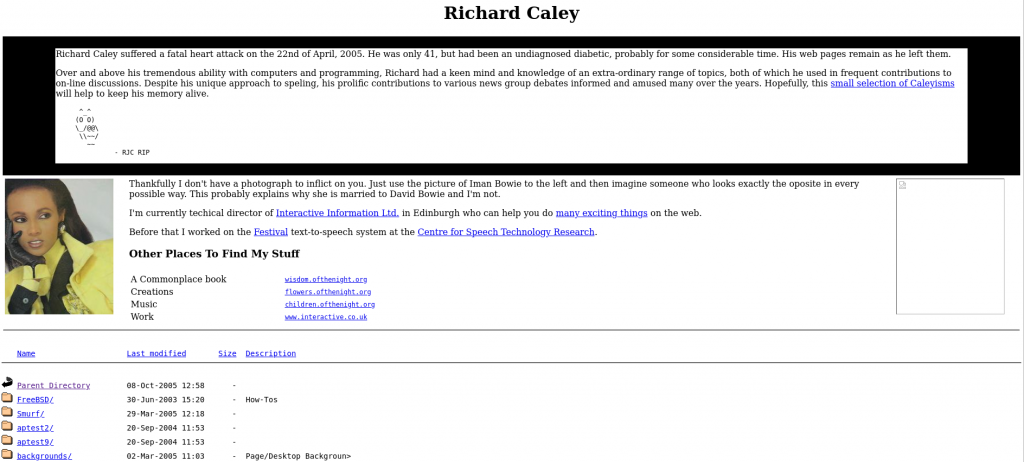
Screenshot of the preserved main page of Richard Caley showing the announcement.
But not every search ends with an answer. Some end in silence.
My research on Richard Caley followed the same digital breadcrumbs. I traced him to the University of Edinburgh, where he worked on speech synthesis. I found his technical contributions to FreeBSD. But the trail went cold around 2005.
Then I found it – not in a USENET archive, but on the front page of his own website, preserved exactly as he left it:
«Richard Caley suffered a fatal heart attack on the 22nd of April, 2005. He was only 41, but had been an undiagnosed diabetic, probably for some considerable time. His web pages remain as he left them.»
Reading those words felt different from finding a historical record. This was not archival research – it was entering someone’s house years after they had gone and finding a note on the table.
The page continued:
«Over and above his tremendous ability with computers and programming, Richard had a keen mind and knowledge of an extraordinary range of topics, both of which he used in frequent contributions to on-line discussions. Despite his unique approach to speling, his prolific contributions to various news group debates informed and amused many over the years.»
The “Caleyisms” – The Man Behind the Code
Screenshot of the “Caleyisms” page showing his witty answers.
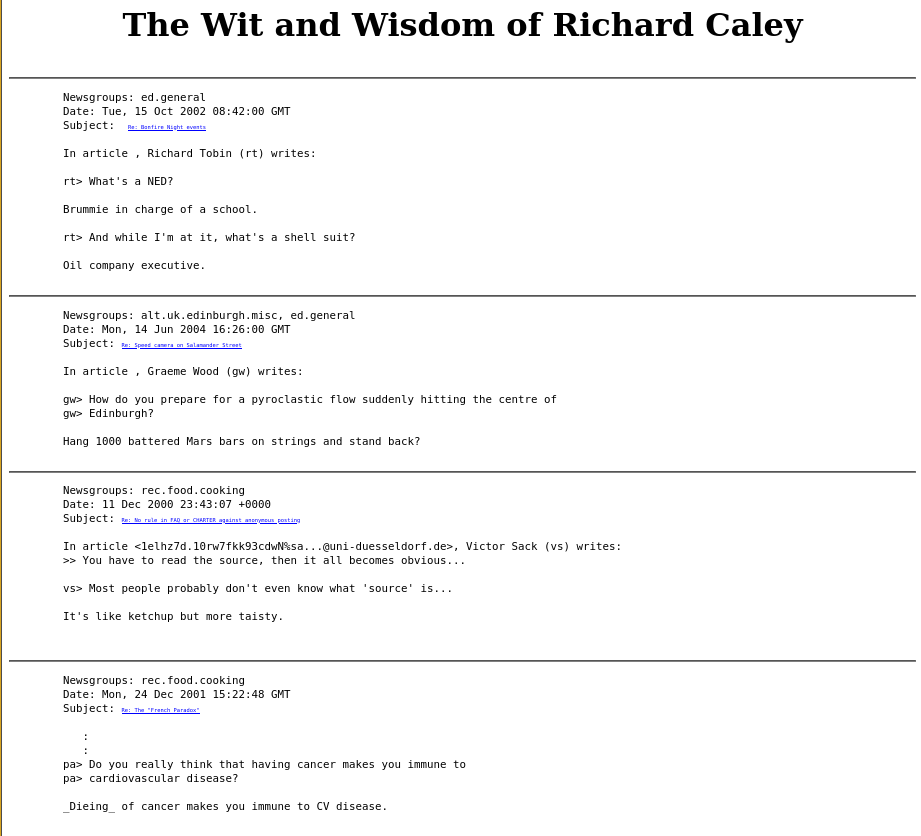
And then I discovered his «Caleyisms» – a curated collection of his brightest answers on USENET that revealed not just a programmer, but a person:
*What’s a shell suit? * «Oil company executive.»
*How do you prepare for a pyroclastic flow hitting Edinburgh? * «Hang 1000 battered Mars bars on strings and stand back?»
*On his book addiction: * «I never got the hang of libraries, they keep wanting the things back and get upset when they need a crowbar to force it out of my hands.»
His humour was dry, intelligent and uniquely British. In technical discussions, he could be brutally precise:
«Lack of proper punctuation, spacing, line breaks, capitalisation etc. is like bad handwriting, it doesn’t make it impossible to read what was written, just harder. But you probably write in green crayon anyway.»*
The Preserved Digital Office
Exploring his preserved website felt like walking through his digital office. The directory structure revealed his passions: FreeBSD how-tos, experiments with POVRAY, background images, technical projects. His self-deprecating humour shone in his “About” section:
«Thankfully I don’t have a photograph to inflict on you. Just use the picture of Iman Bowie to the left and then imagine someone who looks exactly the opposite in every possible way. This probably explains why she is married to David Bowie and I’m not.»*
Here was a complete person – technical director at Interactive Information Ltd, speech synthesis researcher, FreeBSD enthusiast, Kate Bush fan, and a wit who brightened countless online discussions.
The legal reality was harsh: the contributions of Richard to Conquer could not be relicensed. The university could not help to contact heirs because of privacy laws.
Image: The RIP ASCII art from the page of Richard.
His friends had preserved his memory with a simple ASCII tribute at the end of his page:
text
      ^_^
     (O O)
     \_/@@\
      \\~~/
        ~~
               - RJC RIP
In the documentation of the Conquer project, Richard Caley is not remembered as a “problematic case” or “unreleasable code”. He is honoured as the vibrant person he was – the brilliant mind behind the “Caleyisms”, the researcher who contributed to speech synthesis, the FreeBSD advocate, and the witty participant in early online communities whose words continue to amuse and inform, decades after he wrote them.
CHAPTER 7: Technical Rebirth – From USENET to CI/CD
Image: Side by side comparison showing the 1987 shar file and the 2025 GitHub Actions configuration.
The technical transformation has been remarkable. Modernising 1987 code presents unique challenges that require both respect for the original and adoption of modern technologies.
Makefile Archaeology
# Original 1987 - Dependencias hardcodeadas
conquer: conquer.c utils.c
    cc -o conquer conquer.c utils.c -lcurses -ltermcap
# Moderno 2025 - Autotools y detección automática
AC_INIT([conquer], [4.6])
AC_PROG_CC
AC_CHECK_LIB([ncurses], [initscr])
I had to replace assumptions from old systems with automatic library detection. The original Makefiles assumed specific versions of curses and library locations that no longer exist.
The Magic of ttyd – Terminals on the Web
# Dockerfile fragment - Puente tecnológico perfecto
FROM alpine:latest
RUN apk add ttyd ncurses
COPY conquer /usr/local/bin/
CMD ["ttyd", "-p", "7681", "conquer"]
This configuration lets the original curses interface render in modern browsers without modifying a single line of the 1987 code. It is a technological bridge that respects the original while allowing modern access.
Melange and Reproducible Packaging
# conquer.yaml - Construcción reproducible APK
package:
  name: conquer
  version: 4.6
  description: "1987 USENET multiplayer strategy game"
environment:
  contents:
    packages:
      - ncurses-dev
      - gcc
The same game that travelled in 5 USENET parts now generates binary packages with cryptographic hashes and verifiable provenance. The irony: I discovered Melange when a friend started working for the company that created it.
Complete CI/CD Flow
yaml
# GitHub Actions workflow
- name: Build APK package
  run: melange build conquer.yaml
- name: Build Debian package
  run: dpkg-buildpackage -b
- name: Docker build
  run: docker build -t conquer:latest .
Key Technical Achievements:
- GPLv3 relicensing for both v4 and v5
- Modern build system with autotools
- Updated C codebase to support modern ANSI C99
- Debian packaging integration
- APK packaging with Melange for Alpine Linux
- Docker containers with terminal emulation via WebSockets
CHAPTER 8: Historical Context – Conquer in the Unix Games Ecosystem
Image: Fragment of the 1989 “versions of empire” list showing Conquer among other games.
Conquer did not exist in a vacuum. The 1989 “versions of empire” list reveals a flourishing ecosystem of multiplayer strategy games:
- Empire (PSL, UCB, UCSD): Different variants maintained by universities
- Galactic Bloodshed: Focused on exploration and terraforming
- xconq: One of the first to offer an X Window interface
- Buck Empire: Improvements and debugging of a version of PSL Empire
Why Did Conquer Survive When Others Disappeared?
- Modular Architecture: Easy to extend with new races and spells
- Complete Documentation: It included administration guides and data format
- Active Community: Adam Bryant maintained patches for years
- Portability: Written in standard C, with no exotic dependencies
While commercial games from the same period disappeared with their platforms, Conquer survived because it was plain text and open source before the term existed.
The 1989 list presented Conquer like this:
«A multiplayer fantasy wargame written from scratch by Ed Barlow… Not really empire, but close enough to be easily understood by those used to empire. Currently supported by co-author Adam Bryant.»
This reveals a culture where the “competitors” listed each other in a spirit of community. The value was not in intellectual property, but in contributing to a common ecosystem.
CHAPTER 9: The Human Element – Why This 20 Year Odyssey Matters
Image: Collage showing the original code of Ed Barlow, the 2011 email of Adam Bryant, and the 2025 team conversation.
This is not only about preserving games. It is about preserving the very history of computing.
The Pioneers of Software
Ed Barlow and Adam Bryant built sophisticated multiplayer experiences when most people had never heard of the Internet. They distributed software through USENET because that was what you did – you shared cool things with the community.
Martin Forssen and his PostScript utilities represent the ingenuity of the early developers who solved problems with the tools available. Did you want to visualise the state of the game? You wrote a PostScript generator!
Community and Continuity
The 20 year relicensing effort shows something crucial about open source: it is not only about code, it is about community and continuity. Every time someone maintains a legacy project, documents its history, or tracks down lost contributors, they are weaving the threads that connect the computing past with its future.
The journey of Adam between his two messages – from the technical permission to the emotional reflection – encapsulates why preservation matters: the code survives, but the human stories are lost if we do not capture them.
EPILOGUE: Lessons from Software Archaeology
**1. Document Everything ** Those casual USENET posts became crucial legal evidence decades later.
**2. License Clearly ** The comment of Ed that «copyleft didnt exist when i wrote it» highlights how licensing landscapes evolve.
**3. Community is Everything ** Adam found my articles because the preservation community was talking about the project.
**4. Modern Tools Can Revive Old Code ** Melange and CI/CD gave 1987 software a rebirth in 2025.
**5. Technical Debt is Temporary ** What looks like legacy technology today could be the archaeological treasure of tomorrow.
**6. Preserve the Stories, Not Just the Code ** The “Caleyisms” of Richard are as valuable as his technical contributions.
THE STORY CONTINUES
Both Conquer games are now fully licensed under GPLv3 with modern packaging. They are not just playable software, but a complete case study in:
- Software archaeology
- Legal frameworks for preservation
- Evolution of development practices across four decades
The repositories tell the ongoing story:

- Conquer v4 – The original classic

- Conquer v5 – The advanced rewrite
The next chapter: teaching these classic strategy games to a new generation of developers and players, while showing that the right legal frameworks and modern tools can give a second life to any historic software.
Sometimes the best way to learn cutting edge technology is by applying it to preserve computing history.
What historic software deserves preservation in your field? Have you ever traced the lineage of code back to its original creators?
#SoftwareLibre #CodigoAbierto #PreservacionDeSoftware #Unix #GNU #Linux #Empaquetado #Melange #HistoriaTecnologica #DesarrolloDeJuegos #USENET #GPL #FSF #Debian #ncurses #terminal
Read this article in English / Lee este artículo en inglés:

https://vejeta.com/reviving-classic-unix-games-a-20-year-journey-through-software-archaeology/